
Toilets matter…

Child Okeford in the newspapers. A series of stories about a previous generation of villagers as related in the newspapers of the time.
1817 May : “On Monday last an inquest was taken at Child Okeford by Mr Hannen on the body of a child about five years old [son of Thomas Ames] who accidentally fell into a privy on the preceding day.”
How common such accidents were is not known, but the first recorded death in this way was in 1326 when Richard the Raker of London died ‘monstrously, in his own excrement’ whilst cleaning out a cesspit. In towns these pits were in the cellar but for the countryman the privy at the end of the garden was the place to go when you needed to commune with nature.
Whole books have been written about privies; Charles Sale’s ‘The Specialist’ had many good tips but one of them was potentially disastrous, “Dig her deep and dig her wide….”. This avoided the need to continually re-dig the privy but it was probably the child’s undoing as once in he couldn’t scramble out. Digging deep was dangerous for another reason as it risked contaminating the water course and bringing that dread disease – Cholera. During the mid 1800’s there were frequent outbreaks of the disease of which it was truly said that a [wo]man could eat a hearty breakfast in the morning and be dead of the disease by tea time. In 1854 Charles Booth demonstrated, to a medical profession reluctant to believe it, that cholera was spread through the water supply.
The widespread adoption of the water closets around the same time made things worse as an increase in the ratio of water to solid material entering the sewers meant frequent overflows, usually into the local rivers. In the hot summer of 1858 this led to the ‘Big Stink’ in London, when the Thames became little more than liquid sewage. This problem was not confined to London. In 1913 Dr Mivart, the ‘Local Government Board Inspector’ reported on the state of sanitation locally. He noted that that the water supply in Child Okeford was “inadequate or of doubtful quality” and that at Millbrook “The Council should take effectual measures to abate the nuisance caused by the outfall of crude sewage matter into the stream crossing the public road”. This could only have come from water closets in Millbrook House.
Poorer villagers with no running water had to make do with other solutions as one recounted in the Millennium book: “you dug a hole and buried the stuff, but you had to be careful not to dig up the last lot you’d buried.” An even better solution was patented by the Rev. Henry Moule, Rector of Fordington, in 1864. Following a cholera outbreak in Dorchester he invented the earth closet.
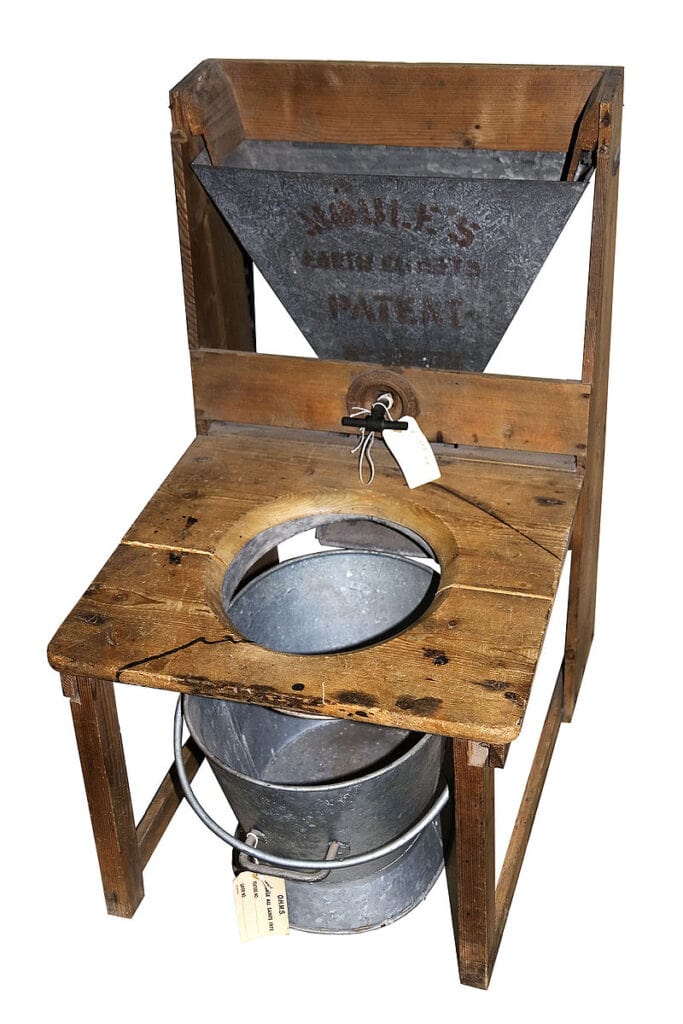
Henry Moule’s Earth Closet
By Musphot – Own work, CC BY-SA 3.0, https://commons.wikimedia.org/w/index.php?curid=3652517
Dried earth was added to the ‘cistern’ at the back and after doing the necessary the user turned the handle releasing a layer of soil onto the recent deposit. The hole in the ground was now replaced with a box in a shed thus minimising the risk of water contamination. Another villager recalled using one of these. “Commodes and slop buckets had to be emptied daily from the bedrooms, and the trek to the shed guarded by the lilac tree in the garden, often at the bottom, with its earth closet and neatly hung pieces of newspaper, was no joy-ride in rain, cold, dark or snow.”
It may be difficult to believe but within a day or two the contents were rendered innocuous and within a week or two a very acceptable form of compost resulted. This was frequently used in the base of a potato trench and those of you have parts of the garden where vegetables grow best might ponder the reason why.
Author’s Note
The original newspaper article has been digitised by British Newspaper Archive in association with the British Library. The transcription is the author’s own work from images downloaded as a part of a paid subscription to the BNA.